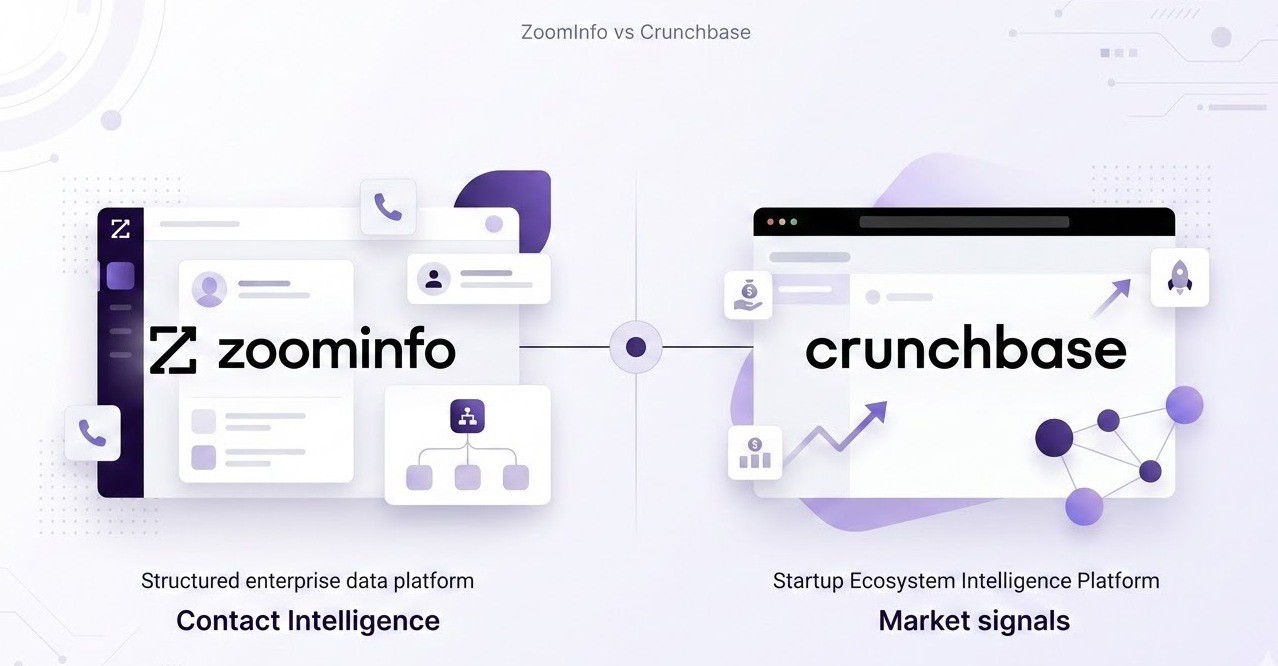

Your outbound pipeline starves without accurate data, but throwing budget at a platform won't fix a broken workflow if the underlying data model doesn't match your actual sales motion. A revenue operations team trying to enrich a CRM isn't just buying rows on a spreadsheet. You are buying a specific architecture that shapes how your reps view the market and prioritize their daily outreach.
The divide between these two tools is strictly operational. If your reps require verified direct dials and deep organizational charts to navigate established enterprise accounts, ZoomInfo is the infrastructure they need.
If your strategy relies on timing your outreach around Series B funding rounds, leadership changes, and firmographic growth signals, Crunchbase maps that market context at a fraction of the cost.
Key Takeaways:
ZoomInfo demands strict annual enterprise commitments because it is engineered specifically to fuel complex, high-volume outbound sales pipelines. Conversely, Crunchbase operates on a flexible, per-user pricing model built for leaner teams focused on tracking fluid startup funding rounds and rapid organizational shifts.
ZoomInfo relies on a proprietary contributory network, paired with AI, to deliver the human-verified contact tiers needed for direct enterprise dialing. Crunchbase scrapes news cycles and aggregates community-driven insights to map broader market context and temporal growth signals rather than granular contact information.
Relying on any single database inherently restricts your total addressable market and leaves critical blind spots in your CRM. If you require absolute precision without being locked into a solitary data silo, FullEnrich deploys a waterfall enrichment technique across 20+ premium vendors to guarantee maximum accuracy and contact coverage.
ZoomInfo vs Crunchbase: Side-by-Side Comparison
This comparison covers data accuracy, workflow fit, pricing structure, and cost efficiency. You'll also learn how to combine both platforms without overlap or waste.
Attribute | ZoomInfo | Crunchbase |
|---|---|---|
Best for | Enterprise sales outreach | Startup & funding research |
Pricing Model | Custom | Per user (Starts ~$49/mo) |
Contract | Strict annual commitment | Monthly or annual options |
Data Approach | Contributory network & AI | Community & news scraping |
Data Compliance | GDPR / CCPA certified | GDPR / CCPA certified |
Integrations | Hubspot, Microsoft, Marketo, Slack, Reltio, Salesforce, Eloqua, Zoom, Tray.io, Outreach | Salesforce, Hubspot, Outreach, Pipedrive, Monday, Clay |
Data Accuracy | Very High (Human-verified tiers) | High (Community-driven) |
Free Trial | 14 days | 7 days |
Service & Support | Dedicated Account Manager ( for enterprise-level plans) | Dedicated Account Manager ( for enterprise-level plans) |
What is ZoomInfo?
ZoomInfo is a B2B contact intelligence platform that supplies verified professional records at enterprise scale. The service maintains work email addresses, direct phone numbers, and organizational charts across millions of business professionals worldwide. Every contact record includes verification attributes, such as confidence tiers and recency indicators, that signal data freshness.
ZoomInfo eliminates the manual work between account identification and contact discovery. You identify target companies, and ZoomInfo returns the people who work there. The platform reveals job titles, department assignments, reporting hierarchies, and buying committee compositions. Your sales team extracts these enriched records into Salesforce or HubSpot through automated sync workflows.
What is Crunchbase?
Crunchbase aggregates private company intelligence across funding rounds, investor networks, and M&A activity. The platform indexes seed-stage through late-stage capital raises alongside acquisition data and investor relationships. Every company records timestamps for funding announcements, leadership changes, and headcount growth that signal expansion readiness.
Crunchbase collapses the distance between account identification and sales readiness signals. You search Crunchbase by funding stage, industry vertical, headquarters location, and investor type. The system returns target accounts matching your growth-stage profile. Your team identifies companies that closed Series B funding last quarter or hired 50 employees in the past six months.
What Services Does ZoomInfo and Crunchbase Offer?
The breakdown below strips away the marketing claims to reveal the operational reality: ZoomInfo engineers the infrastructure required to execute high-velocity enterprise outbound, while Crunchbase maps the strategic intelligence necessary to track startup growth and perfectly time your outreach.
ZoomInfo Services
ZoomInfo structures its services through modular "OS" platforms designed to centralize sales and marketing operations. These services facilitate large-scale prospecting by providing deep access to professional profiles and the tools needed to engage them.
SalesOS: A flagship service providing a searchable database of 320+ million professional contacts and 100+ million company profiles, including direct-dial mobile numbers.
MarketingOS: A demand-generation service that offers buyer intent data, website visitor identification, and cross-channel advertising capabilities.
TalentOS: A specialized recruitment service for sourcing candidates, mapping organizational structures, and managing candidate outreach.
OperationsOS: A data hygiene service that automates CRM cleansing, data enrichment, and complex lead routing.
Chorus (Conversation Intelligence): An AI-driven service that records and analyzes meetings to provide sales coaching and sentiment insights.
Crunchbase Services
Crunchbase provides services focused on "buy signals" and private-market intelligence. The platform offerings prioritize identifying high-growth companies based on financial activity rather than pure contact volume.
Crunchbase Pro: A professional search service that provides advanced filters for funding rounds, investment stages, and recent M&A activity.
Crunchbase Business: A team-oriented service that includes centralized billing, data export capabilities, and CRM sync for shared lists.
Crunchbase Scout.: An AI-powered research assistant that analyzes market activity and recommends companies based on specific growth criteria.
Data Enrichment & API: A technical service that allows companies to pull Crunchbase’s proprietary funding and firmographic data directly into their own internal tools.
Funding & M&A Tracking: A real-time monitoring service that provides alerts on venture capital rounds, IPO filings, and leadership changes at high-growth startups.
Key Features of ZoomInfo vs Crunchbase
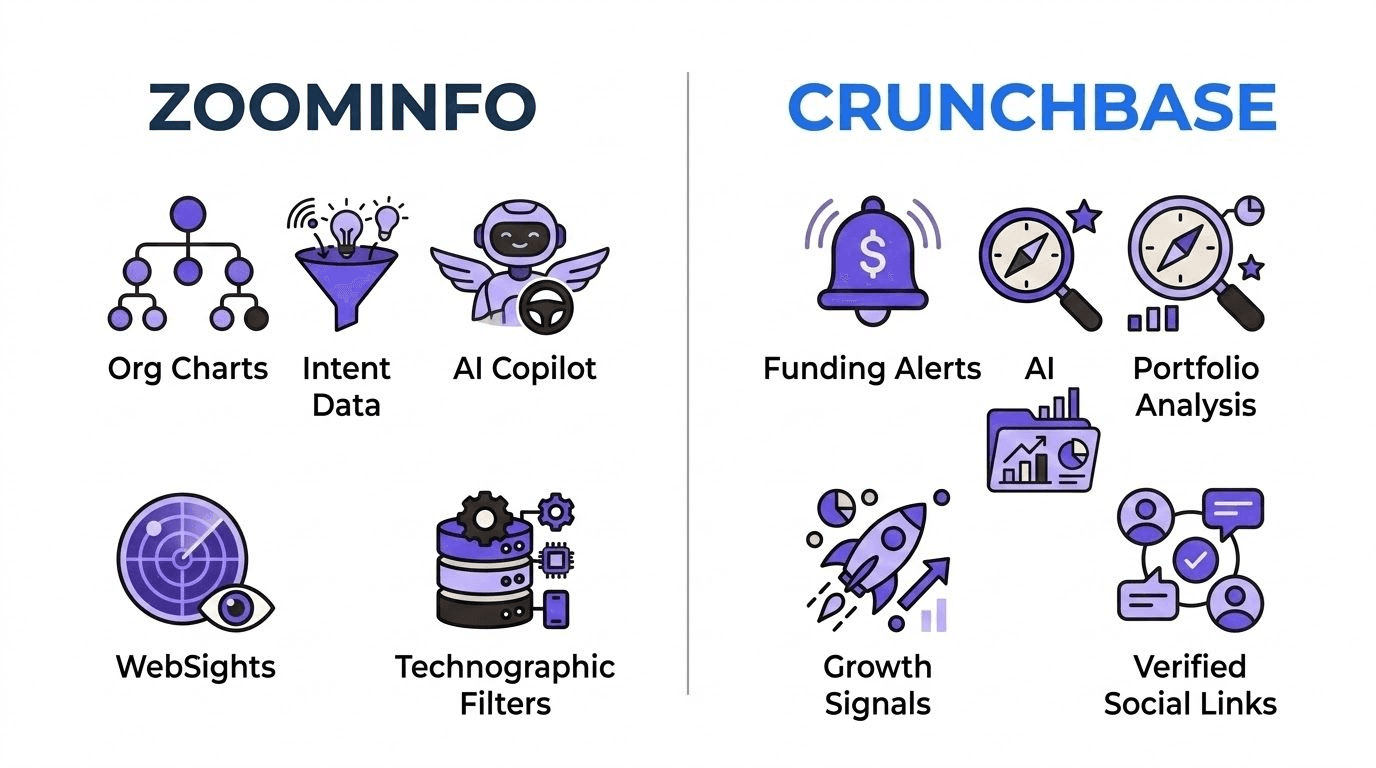
ZoomInfo and Crunchbase utilize advanced technical architectures to provide specialized business intelligence. ZoomInfo prioritizes sales execution through its massive contact database and integrated outreach tools. Crunchbase, conversely, focuses on market discovery by tracking financial signals, venture capital movements, and emerging startup trends.
ZoomInfo Features
ZoomInfo is built around a proprietary data collection engine that prioritizes direct access to decision-makers. Its key features are designed to move a lead from the discovery phase into a live conversation within a single environment.
Org Charts & Hierarchy Mapping: Visual representations of company reporting structures that allow sales teams to identify buying committees and executive influencers.
Streaming Intent Data: A monitoring feature that tracks web consumption patterns across thousands of B2B topics to pinpoint accounts currently in a buying cycle.
Copilot (AI Sales Assistant): An integrated AI agent that analyzes your "Ideal Customer Profile" (ICP) to automatically recommend leads and draft personalized outreach.
WebSights: A visitor intelligence feature that identifies anonymous companies visiting your website, linking them back to specific ZoomInfo profiles for immediate follow-up.
Technographic Filters: Advanced search parameters that filter companies based on their current technology stack, such as identifying all firms using specific CRM or ERP systems.
Crunchbase Features
Crunchbase uses a community-driven, AI-verified data model to provide a clear view of the global startup landscape. Its key features focus on "early-stage signals" that indicate a company is ready to scale or purchase new services.
Funding & Exit Alerts: Real-time notifications for venture capital rounds (Seed through Series J), IPO filings, and corporate acquisitions.
Crunchbase Scout: A natural-language AI search tool that allows users to find companies by describing a market trend or a specific competitive landscape.
Investment Portfolio Analysis: Tools that allow users to track the performance and newest additions to specific Venture Capital and Private Equity portfolios.
Buy Signals & Growth Indicators: Proprietary filters that track company growth based on headcount shifts, leadership changes, and recent news sentiment.
Verified Social & Web Links: Direct integration with LinkedIn, Twitter, and corporate websites to facilitate quick research and cross-platform verification.
How Accurate Is the Data from ZoomInfo and Crunchbase?
ZoomInfo and Crunchbase use different methods to maintain their databases, resulting in different levels of accuracy for contact and company data. ZoomInfo relies on a contributor network and AI to track professional transitions. Crunchbase uses a community-driven model and AI validation to track private-market signals.
ZoomInfo Accuracy
ZoomInfo does not rely solely on automated web scraping to build its organizational charts. Its accuracy depends on a multi-layered verification architecture that pairs machine learning with continuous human-in-the-loop oversight. By ingesting billions of daily data points through a proprietary contributory network, users consistently achieve higher baseline accuracy than static lists provide. If a prospect changes companies, the OperationsOS module automatically flags the record with freshness signals, preventing sales development representatives from executing cadences against obsolete direct dials.
G2 ZoomInfo Reviews indicates that the platform’s highest-tier data can push CRM enrichment accuracy to exceptional levels. However, this vast coverage model carries a specific operational requirement. If a revenue operations team indiscriminately syncs AI-sourced profiles without filtering by the platform's internal confidence scores, the resulting database hygiene will degrade.
Also Read: 15 Best ZoomInfo Competitors & Alternatives
Crunchbase Accuracy
Crunchbase does not rely on scraping static corporate directories to maintain its status as the industry standard for private market intelligence. Instead, it builds baseline accuracy through direct ecosystem integration. The platform’s foundation rests on a Venture Program Network where more than 4,000 venture capital firms submit monthly portfolio updates, locking in officially verified funding rounds and cap table shifts. This direct pipeline is continuously expanded by a stewardship network of over 600,000 active founders and investors who manually update organizational profiles as rapid milestones occur.
To prevent this massive volume of crowdsourced intelligence from degrading into noise, the system routes all inputs through a strict validation architecture. Over 400 specialized AI algorithms cross-reference contributor updates while simultaneously scanning daily signals from more than 2,000 news outlets and government filings to capture real-time acquisition and IPO data. When the system detects high-impact market movements, an internal team of data analysts steps in to provide 24/7 manual curation.
Which Platform Offers the Most Intuitive User Experience?
ZoomInfo and Crunchbase provide fundamentally different interfaces. The user experience on ZoomInfo focuses on comprehensive sales orchestration, with a broad range of features across its SalesOS, MarketingOS, and TalentOS modules. While this depth allows enterprise teams to manage their entire go-to-market strategy in one place, it creates a steeper learning curve that often requires dedicated onboarding to master its cluttered, high-density dashboard.
ZoomInfo UX
ZoomInfo, conversely, uses a dashboard-heavy architecture to support its advanced engagement tools, such as Chorus and Engage. The interface is built for the "power user" who needs to toggle between organizational charts, intent signal feeds, and automated call queues.
To alleviate the complexity, ZoomInfo has integrated "Copilot," an AI assistant that uses natural language processing to help users navigate the platform.
Despite these improvements, the sheer volume of data points, from technographics to streaming intent, can still overwhelm users accustomed to simpler prospecting tools.
Crunchbase UX
Crunchbase prioritizes a clean, search-first interface that mirrors the simplicity of a modern search engine. The platform is designed for quick discovery, allowing users to move from a broad industry query to a specific company profile in a few clicks. Its "Kanban-style" tracker boards and intuitive filtering sidebar make it easy for founders and analysts to monitor market shifts without the technical bloat found in enterprise-grade platforms.
Pricing and Plans
ZoomInfo and Crunchbase operate on fundamentally different financial models to reflect their distinct service levels. ZoomInfo maintains a high-entry enterprise model that requires significant annual investment, whereas Crunchbase provides a tiered, subscription-based approach accessible to individual researchers and small teams.
ZoomInfo Pricing
ZoomInfo utilizes a complex, credit-based pricing structure that is rarely disclosed publicly and typically requires negotiation with a sales representative. Plans are billed annually, with no monthly payment option, reinforcing its enterprise-grade status.
Entry-Level Plans (Est. $14,995/year): The entry-tier plan includes core contact and company data for up to 3 users, but excludes premium features such as intent signals and organizational charts.
Mid-Tier Plans(Est. $24,995/year): Designed for growing teams, this tier adds technographics, department-level org charts, and buyer intent data to help prioritize outreach.
Enterprise Plans ( Est. $39,995+/year): The top-tier offering provides the full suite of "GTM" tools, including advanced AI automation, pipeline management, and priority support for large organizations.
Variable Costs: Beyond the base fee, ZoomInfo charges approximately $1,500 to $2,500 per additional user seat and requires separate add-on fees for global data (approximately $9,995) and specialized AI features.
Crunchbase Pricing
Crunchbase offers a transparent, self-service pricing model that serves a broad range of users, from solo entrepreneurs to corporate development teams. The 2026 plans focus on providing access to the private market database without the massive upfront commitment required by its competitors.
Pro Plan ($49/month, billed annually): The most popular tier, offering unlimited search results, 1,000 monthly exports, and access to the full dataset of funding rounds and investment signals.
Pro Monthly ($99/month): A flexible version of the Pro plan for users who do not want to commit to a full year of service.
Business Plan ($199/month, billed annually): Aimed at teams, this plan includes the "Crunchbase Scout" AI agent, CRM integrations (Salesforce/HubSpot), and higher export limits (5,000 per month).
Enterprise Plan (Custom): A bespoke tier for large organizations requiring full API access, unlimited exports, and dedicated customer success management.
Who Should Buy ZoomInfo vs Crunchbase?
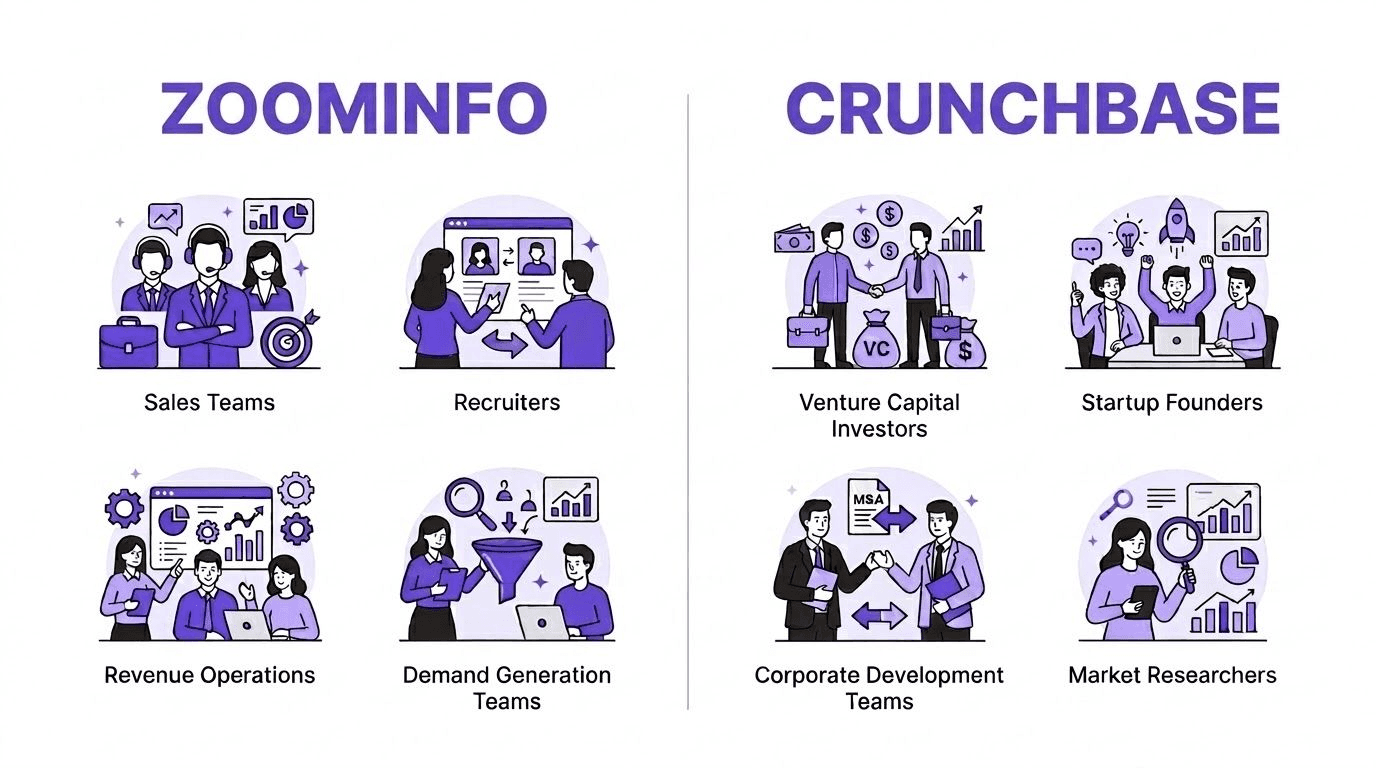
ZoomInfo and Crunchbase cater to distinct professional segments within the business ecosystem by providing different layers of intelligence. ZoomInfo focuses on the "execution" phase of sales, providing the depth of contact required for high-volume outreach. Crunchbase focuses on the "discovery" phase, offering the financial and market signals needed for strategic research and investment analysis.
Who uses ZoomInfo?
ZoomInfo is engineered for organizations operating at high velocity that need to bypass gatekeepers to reach decision-makers directly.
Enterprise Sales Teams: SDRs and AEs use the platform to identify buying committees and access mobile numbers for cold calling campaigns.
Talent Acquisition & Recruiters: HR professionals utilize TalentOS to source passive candidates by mapping organizational charts and tracking job changes.
RevOps & Data Managers: Teams use OperationsOS to automate CRM data cleansing and ensure their lead routing logic is based on accurate, real-time firmographics.
Demand Gen Marketers: Marketing teams leverage MarketingOS to trigger display ads and email workflows based on specific intent signals and website visitor identification.
Who uses Crunchbase?
Crunchbase is designed for users who need a strategic overview of the global startup landscape and private market financial movements.
Venture Capitalists & Private Equity: Investors use the platform to track deal flow, monitor competitors' portfolios, and identify emerging sectors such as AI and robotics.
Startup Founders: Entrepreneurs use the data to research competitive funding rounds, identify potential lead investors, and benchmark their growth against industry peers.
Corporate Development Teams: M&A professionals track "probable" IPO candidates and acquisition targets by monitoring capital concentration and leadership shifts.
Business Development Reps (Strategic): High-level sellers use Crunchbase to prioritize accounts that have recently raised capital or are experiencing rapid headcount growth.
Pros and Cons of ZoomInfo vs Crunchbase
ZoomInfo and Crunchbase offer specialized advantages that cater to different operational priorities. ZoomInfo provides an extensive, execution-ready database for high-volume sales, while Crunchbase delivers high-fidelity financial signals for market analysis. The trade-off typically involves choosing between ZoomInfo’s superior contact depth and higher price point versus Crunchbase’s more accessible pricing and market-discovery focus.
ZoomInfo Pros and Cons
ZoomInfo is the market leader for teams that require volume and direct access to North American decision-makers, but its enterprise-first approach introduces specific operational hurdles.
ZoomInfo Pros:
Direct Contact Depth: Offers the highest volume of verified mobile numbers and direct dials in the B2B industry.
Advanced Market Intelligence: Features such as "Streaming Intent" and "Technographics" enable precision targeting based on actual buyer behavior and existing tech stacks.
All-in-One Sales Suite: Native tools such as Chorus and Engage eliminate the need for third-party call-recording or email-sequence software.
ZoomInfo Cons:
High Entry Cost: Minimum annual contract terms start at ~$15,000, making it prohibitive for startups and individual users.
Rigid Contract Terms: Multi-year agreements and auto-renewal clauses are standard, offering very little flexibility for scaling down.
Feature Overload: The density of modules can lead to low adoption rates without dedicated training and RevOps support.
Crunchbase Pros and Cons
Crunchbase is the primary resource for tracking growth-stage companies and investment activity, though it is not designed as a standalone contact-sourcing tool.
Crunchbase Pros:
Investment Accuracy: Unrivaled tracking of Seed through Series J funding rounds, acquisitions, and IPO filings.
Flexible Pricing: Monthly subscription options and low-cost annual tiers make it accessible to founders and small business development teams.
Intuitive UX: A clean, search-centric interface that requires almost zero onboarding time to begin building company lists.
Crunchbase Cons:
Limited Contact Data: Lacks verified mobile numbers and consistent email patterns, often requiring a secondary tool for outreach.
Data Latency: While funding data is real-time, basic firmographics for non-US or mid-market companies can sometimes lag by several months.
Restricted Exports: Lower-tier plans impose strict monthly lead export limits, which may hinder high-volume campaigns.
Which One Is a Better Option?
The decision between ZoomInfo and Crunchbase depends on whether a team prioritizes high-volume sales execution or strategic investment research. ZoomInfo operates as a robust enterprise engine for mapping complex corporate hierarchies and accessing direct-dial contact data, though it requires a high-tier annual financial commitment.
Crunchbase serves as the definitive source for tracking venture capital, funding rounds, and emerging market trends through an accessible, search-centric interface.
The primary challenge remains data fragmentation, as single-source databases often fail to provide complete coverage for every prospect.
FullEnrich functions as the logical alternative for teams that need to maximize contact match rates without the restrictive costs of enterprise contracts. While ZoomInfo and Crunchbase offer specialized insights, FullEnrich uses a 20+ provider waterfall engine to identify verified mobile numbers and email addresses that single-source tools often miss.
Bonus read: If you want to learn about data enrichment platforms, check out Best Data Enrichment Tools.
Frequently Asked Questions (FAQs)
Can I use Crunchbase solely for cold calling?
Technically, yes, but it isn’t recommended. Crunchbase is a strategic "discovery" tool designed to track funding and growth signals. While it provides some contact data, it often lacks verified direct-dial mobile numbers required for a successful cold-calling campaign.
Does ZoomInfo or Crunchbase offer better data for the European market (GDPR)?
While ZoomInfo has expanded its global footprint, Crunchbase’s community-driven model often captures European startup trends more effectively. However, both platforms are US-centric.
Is there a way to get Crunchbase’s funding signals AND ZoomInfo’s contact depth?
Yes, and it’s more affordable than you think. The most efficient workflow involves exporting your high-signal targets from Crunchbase and running them through FullEnrich. The strategic intelligence of a startup tracker and the verified mobile data of an enterprise engine, all at a fraction of the cost.
Why are my emails still bouncing if the data is "verified"?
Static databases (like traditional ZoomInfo or Crunchbase exports) decay at a rate of 2% per month. If your data was verified 30 days ago, it’s already becoming obsolete. The modern solution is Triple-Verification, which validates emails in real time to guarantee 99% deliverability.



Other Articles
Cost Per Opportunity (CPO): A Comprehensive Guide for Businesses
Discover how Cost Per Opportunity (CPO) acts as a key performance indicator in business strategy, offering insights into marketing and sales effectiveness.
Cost Per Sale Uncovered: Efficiency, Calculation, and Optimization in Digital Advertising
Explore Cost Per Sale (CPS) in digital advertising, its calculation and optimization for efficient ad strategies and increased profitability.
Customer Segmentation: Essential Guide for Effective Business Strategies
Discover how Customer Segmentation can drive your business strategy. Learn key concepts, benefits, and practical application tips.