
Cognism and ZoomInfo are leading B2B data platforms, but they target slightly different workflows.
Cognism emphasizes global lead generation, GDPR-compliant data, and enriched prospect lists for outbound campaigns.
ZoomInfo focuses on comprehensive company and contact intelligence with deep integration into sales and marketing workflows.
Learning about these tools will help SDRs, sales leaders, RevOps, and marketing teams determine which platform best aligns with their outreach, enrichment, and pipeline-building needs.
Key Takeaways
Cognism is the specialist for teams that prioritize high-quality mobile data and strict European compliance. While other tools often struggle with GDPR or outdated office lines, Cognism focuses on providing "Diamond-verified" mobile numbers.
ZoomInfo remains the heavyweight champion for large enterprise teams that need deep intelligence on US-based companies. It’s more than just a contact list; it’s a massive data engine that tracks intent, hiring trends, and organisational charts.
FullEnrich bridges the gap that both leave, specifically the high "entry price" and the limitations of a single-source database. While ZoomInfo and Cognism require massive five-figure annual commitments, we offer a "waterfall" approach that queries 20+ premium providers in real-time.
Cognism vs ZoomInfo: Side-by-Side Comparison
Let’s look at this quick comparison to understand how Cognism and ZoomInfo differ in data coverage, pricing, automation, and ideal use case for modern B2B teams.
Attributes | Cognism | ZoomInfo |
|---|---|---|
Best For | Global outreach and GDPR-compliant B2B prospecting | Enterprise-level sales and marketing teams need comprehensive company and contact intelligence |
Core Focus | Lead generation, prospect enrichment, and compliance-focused data | Deep company and contact intelligence with integrated sales and marketing workflows |
Primary Users | SDRs, sales leaders, marketing ops, global GTM teams | Sales teams, RevOps, marketing ops, and enterprise GTM teams |
Data Source | Aggregated global B2B datasets, proprietary sources | Aggregated B2B datasets, company filings, news, and proprietary intelligence |
Automation | Moderate; lead enrichment and list building automated | High enrichment, scoring, and CRM sync are automated |
Pricing Model | Custom Quote, but estimated at around ~$16,500/year | Custom Quote, but estimated at around ~ $14,995/yr per year |
Integration | CRM integrations (Salesforce, HubSpot), outbound tools | CRM, marketing automation, engagement platforms, and analytics tools |
Data Compliance | GDPR, CCPA compliant | GDPR, CCPA compliant |
Support | Email, chat, and account manager on higher tiers | Email, chat, knowledge base, and dedicated account managers for enterprise |
What is Cognism?
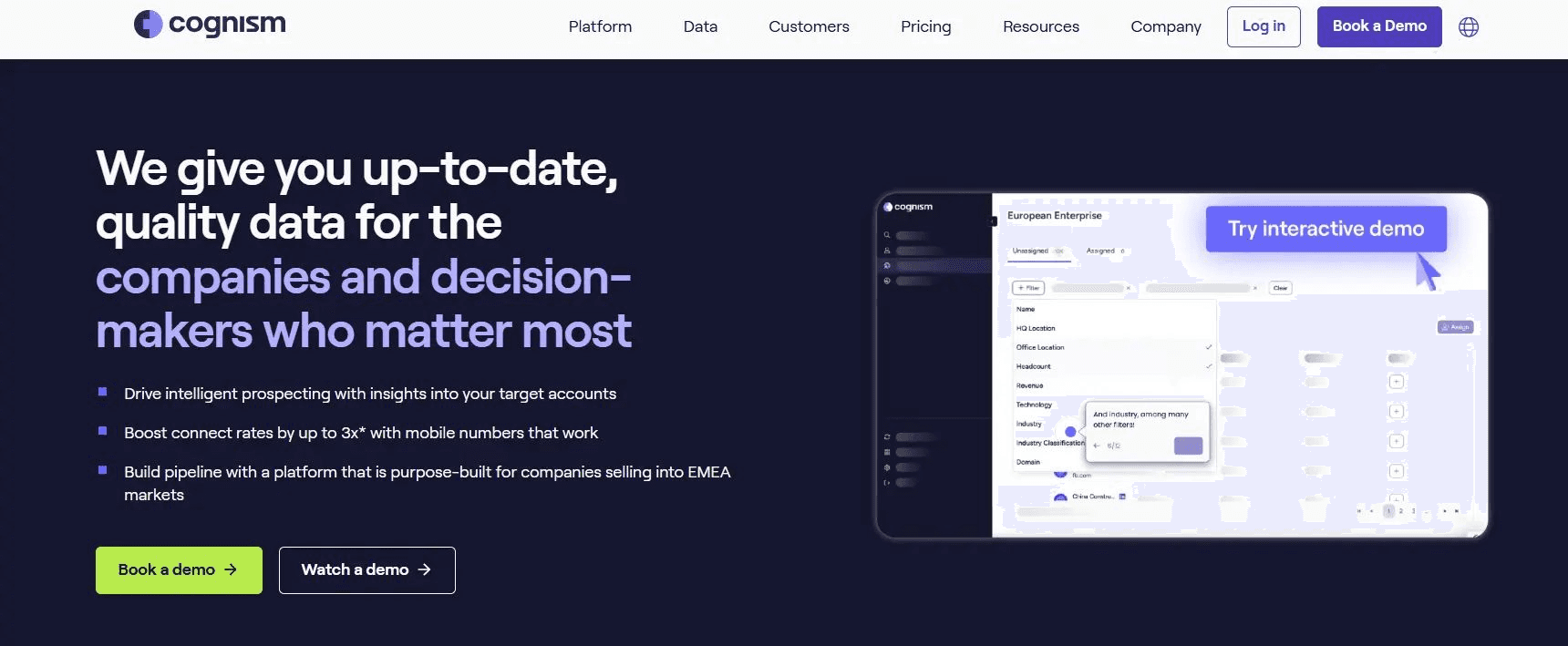
Cognism is a GDPR-compliant B2B lead generation and data platform designed to help teams build accurate and compliant pipelines across global markets. It specializes in providing verified email addresses, direct-dial phone numbers, and enriched company insights, making it easier for sales and marketing teams to target decision-makers effectively.
The platform emphasizes compliance, ensuring that all lead data adheres to GDPR and CCPA regulations, which is especially critical for teams operating internationally. Cognism also offers automation features for lead enrichment, list building, and campaign management.
What is ZoomInfo?
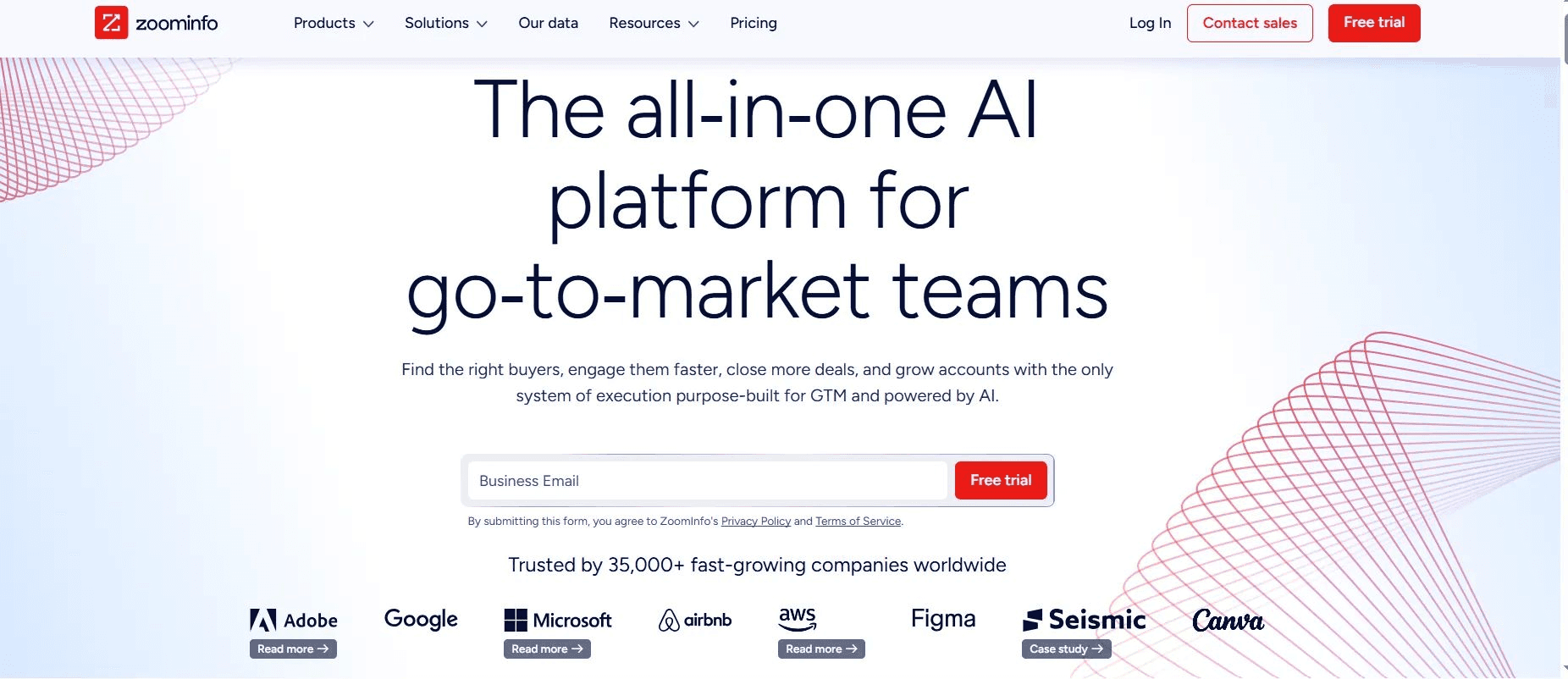
ZoomInfo is an enterprise-grade B2B intelligence platform that delivers comprehensive company and contact information to support sales, marketing, and RevOps workflows. It combines multiple data sources, proprietary verification algorithms, and AI-driven enrichment to provide detailed profiles of companies and decision-makers.
Beyond raw data, ZoomInfo integrates with CRMs, marketing automation platforms, and engagement tools, enabling teams to streamline prospecting, campaign execution, and analytics. It also provides firmographic and technographic insights, intent data, and detailed account intelligence.
What Services Do Cognism and ZoomInfo Offer?
Cognism and ZoomInfo serve B2B teams differently, reflecting their core focus. Cognism emphasizes GDPR-compliant global lead generation and outbound-ready prospect lists, while ZoomInfo focuses on deep company intelligence, CRM integration, and multi-layered enrichment.
Services Offered by Cognism
Cognism is widely recognized as the premium choice for teams that live and breathe outbound calling, especially within the European market. Their service model isn't just about providing a list; it’s about providing "clean" data that has been manually scrubbed.
Diamond Data® (Phone Verification Service): This is Cognism’s flagship offering. Unlike standard databases that scrape numbers and hope for the best, this service involves a dedicated team that manually calls and verifies mobile numbers.
On-Demand Data Research: If you are targeting a hyper-specific niche that isn't currently in their database, Cognism offers a "concierge" research service. You can request a custom-built list for a specific territory or industry, and their team will hunt down and verify those contacts for you.
Scheduled CRM Enrichment: To prevent "data decay," Cognism offers a service that runs in the background of your CRM (like Salesforce or HubSpot). It periodically refreshes your existing records, automatically updating job titles and phone numbers.
Services Offered by ZoomInfo
ZoomInfo functions as a massive, enterprise-grade intelligence engine. Their services go far beyond simple lead lists, focusing instead on "Go-To-Market" (GTM) orchestration.
Account-Based Intelligence (SalesOS): This service maps out the internal "org charts" of nearly every major company in North America. It tells you not just who the CEO is but who reports to whom, which departments are growing, and who the actual budget-holders are.
Automated Data Hygiene (OperationsOS): This service is designed for RevOps teams who struggle with messy data. It automatically deduplicates, standardizes, and enriches your internal database.
Intent-Based Targeting (MarketingOS): ZoomInfo offers a service that monitors billions of "buying signals" across the web. It flags accounts that are actively researching keywords related to your product, allowing your marketing team to trigger automated ads or sales sequences at the exact moment a prospect is in a buying cycle.
What Are the Key Features of Cognism and ZoomInfo?
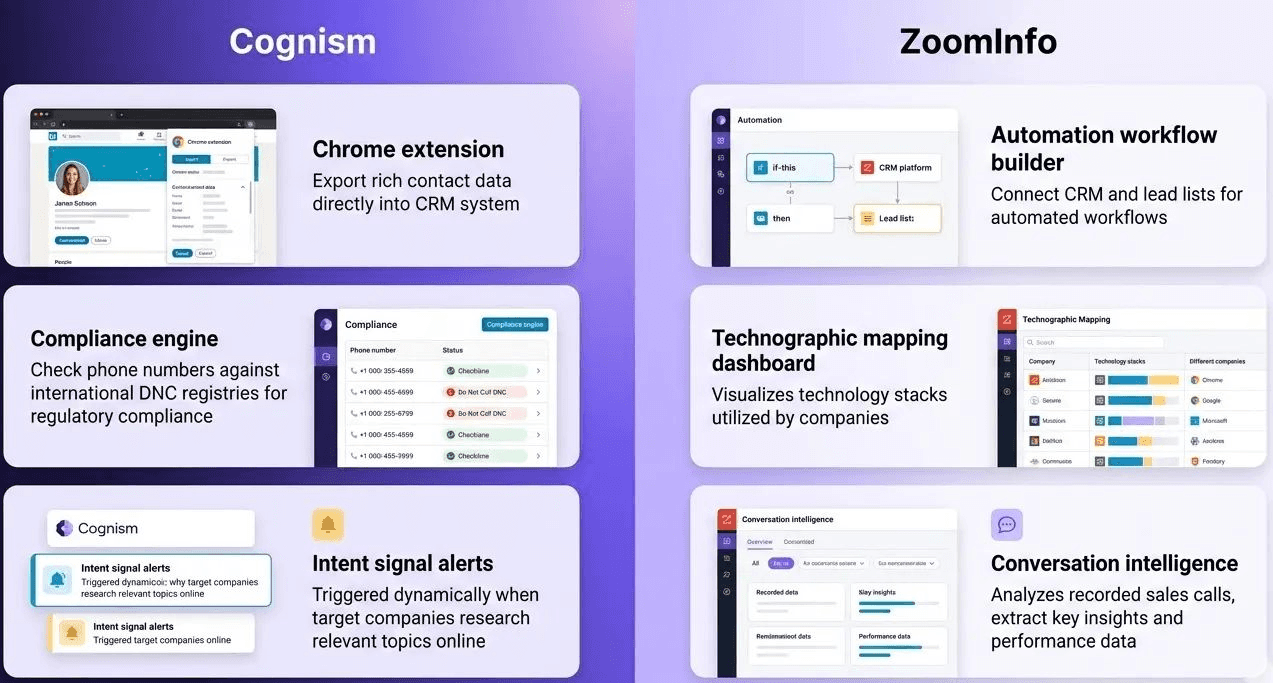
Key features differentiate Cognism and ZoomInfo by showing how each platform supports B2B teams beyond basic data access. Cognism emphasizes compliance, global reach, and outbound readiness, while ZoomInfo emphasizes integrated intelligence, automation, and analytics.
Key Features of Cognism
While Cognism’s services focus on delivering and verifying data, its features are the specific technical tools within the platform that allow your team to filter, trigger, and manage that data.
The "Sales Companion" Chrome Extension: This feature acts as a technical bridge between your browser and your CRM. When you are on a LinkedIn profile or a company website, the extension "overlays" Cognism’s data, allowing you to export that contact directly into Salesforce or HubSpot with a single click without ever leaving the page.
Multi-Country DNC Scrubbing: This is a built-in compliance engine. The feature automatically cross-references every phone number against 15+ international "Do-Not-Call" registries in real-time.
Bombora-Powered Intent Triggers: Cognism integrates a specialized intent feature that flags accounts based on third-party surges in specific topics. This allows you to set up "alerts" so that the platform notifies you the moment a target company starts researching a keyword related to your service.
Key Features of ZoomInfo
ZoomInfo’s features are built to handle the complexity of enterprise-level sales. These are the high-powered tools within the SalesOS platform that enable a team to map out massive organizations and automate data flow into their internal systems.
"Workflows" Automation Engine: This logic-based feature allows you to set up "If-This-Then-That" scenarios. For example, you can create a workflow that says: "If a company in the Manufacturing sector hires a new CTO, automatically export their contact info to my CRM and tag them as a hot lead."
Technographic Mapping: This feature allows you to "peer" into a company's tech stack. You can search for accounts based on the specific software they use, such as finding every company that currently uses Oracle or AWS.
Chorus Conversation Intelligence: Following its acquisition of Chorus, ZoomInfo now features a built-in AI tool that records and analyzes sales calls. It identifies "keywords" and "pain points" mentioned during a conversation, providing a technical summary of the call's sentiment directly inside the lead's profile.
How Accurate Is the Data from Cognism and ZoomInfo?
Data accuracy directly impacts campaign success, lead quality, and ROI. Cognism and ZoomInfo approach verification differently: Cognism focuses on compliance and global validation, while ZoomInfo emphasizes enterprise-scale verification with multi-source intelligence.
Cognism Data Accuracy
Cognism has built its reputation as the most reliable source of European data, particularly for phone numbers. Instead of just scraping the web and hoping for the best, they use a "Diamond Data" approach, in which a human team manually calls and verifies mobile numbers to ensure they are active. This significantly reduces the time sales reps spend talking to gatekeepers or hitting dead ends.
Because of this focus on manual verification and strict GDPR compliance, users on G2 consistently rate Cognism 4.5/5 stars, with many reviews highlighting that their "connect rates" (the number of times a real person actually answers) are significantly higher than on other platforms.
Also Read: Best Cognism Alternatives and Competitors
ZoomInfo Data Accuracy
ZoomInfo is the undisputed heavyweight in sheer data volume, particularly in North America. Their accuracy comes from a massive "contributor network" and sophisticated machine learning that processes millions of data points every day. While they provide an incredible breadth of information, including deep org charts and hiring signals, the trade-off for such a massive database is "data decay."
In a database of hundreds of millions of entries, some will inevitably be a few months behind. However, for teams targeting the US market, the depth is hard to beat. Most professional teams find that ZoomInfo is exceptionally accurate for company-level intelligence (who to target)
Also Read: Best ZoomInfo Competitors & Alternatives
Which Platform Offers the Most Intuitive User Experience?
User experience determines how quickly teams can onboard, adopt, and leverage a platform for sales and marketing success. Cognism focuses on outbound-ready, compliance-first workflows, while ZoomInfo provides deep intelligence integrated into sales and marketing systems for enterprise efficiency.
Cognism User Experience
Cognism provides a user-friendly SaaS interface that enables SDRs, sales leaders, and marketing teams to quickly build and segment prospect lists. The platform offers pre-validated, outbound-ready contacts and campaign-ready lists, reducing manual data work. Onboarding includes ICP definition, global targeting setup, and CRM integration.
ZoomInfo User Experience
ZoomInfo offers an intuitive dashboard with search, segmentation, and enrichment tools, integrated directly with CRMs and marketing automation platforms. Users can explore company and contact intelligence, prioritize leads, and track campaign engagement through analytics dashboards. Onboarding involves account setup, CRM integration, and platform training for analytics and prospecting workflows.
Pricing and Plans
Understanding pricing helps teams align platform capabilities with budget, scale, and outreach needs. Cognism uses subscription-based pricing for global, compliant lead generation, while ZoomInfo uses tiered subscription plans with enterprise features for integrated intelligence and enrichment.
Cognism Pricing Plans
Cognism operates on a "platform fee plus user seat" model. While they keep their official rates under wraps until you speak with a rep, third-party sources and professional benchmarks suggest the following ranges. Keep in mind that renewals often come with a price increase, and there are several "hidden" costs, like onboarding fees that can range from $500 to $1,500.
Grow Plan (Estimated $15,000+ per year): This is the entry-level plan, typically comprising a $14,000 base platform fee and a $ 1,500-per-user annual charge. It covers the essentials for a small sales team.
Elevated Plan (Estimated $25,000+ per year): This mid-tier option usually carries a $20,000+ platform fee and roughly $2,500 per user. It unlocks more advanced features and higher data limits.
Enterprise Plan (Estimated $35,000 - $100,000+ per year): For massive global organizations, costs scale quickly with the volume of "Diamond-verified" leads and the number of required global territories.
Potential Add-ons: Be aware that "Intent Data" isn't always included; tracking specific topics can add $200 to $400 per topic to your bill.
Also Read: Cognism Pricing (2026): Is it worth it?
ZoomInfo Pricing Plans
ZoomInfo is known for its aggressive enterprise pricing. They focus on annual contracts and rarely offer month-to-month options. While they are famous for high quotes, they are also known to be open to negotiation.
ZoomInfo Lite ($0): A surprising "no-cost" option that offers a stripped-back version of the tool. It typically provides 10 to 25 contacts per month.
Professional (Estimated $14,995 per year): This is the "starter" pack for small teams. It gives you access to the core database and basic features, but limits the depth of intelligence you can pull from it.
Advanced (Estimated $24,995 per year): The mid-tier choice for established sales departments. It adds deeper org charts, technographic data, and more automated workflows.
Elite (Estimated $39,995+ per year): The top-tier plan for enterprise power users. This includes intent signals, real-time alerts, and the full suite of "OS" tools.
The "Extras": Watch out for credit overages, which can cost anywhere from $0.60 to $3.00 per contact. Moreover, an extra seat could cost around $2,500 per year.
Who Should Use Cognism vs ZoomInfo?
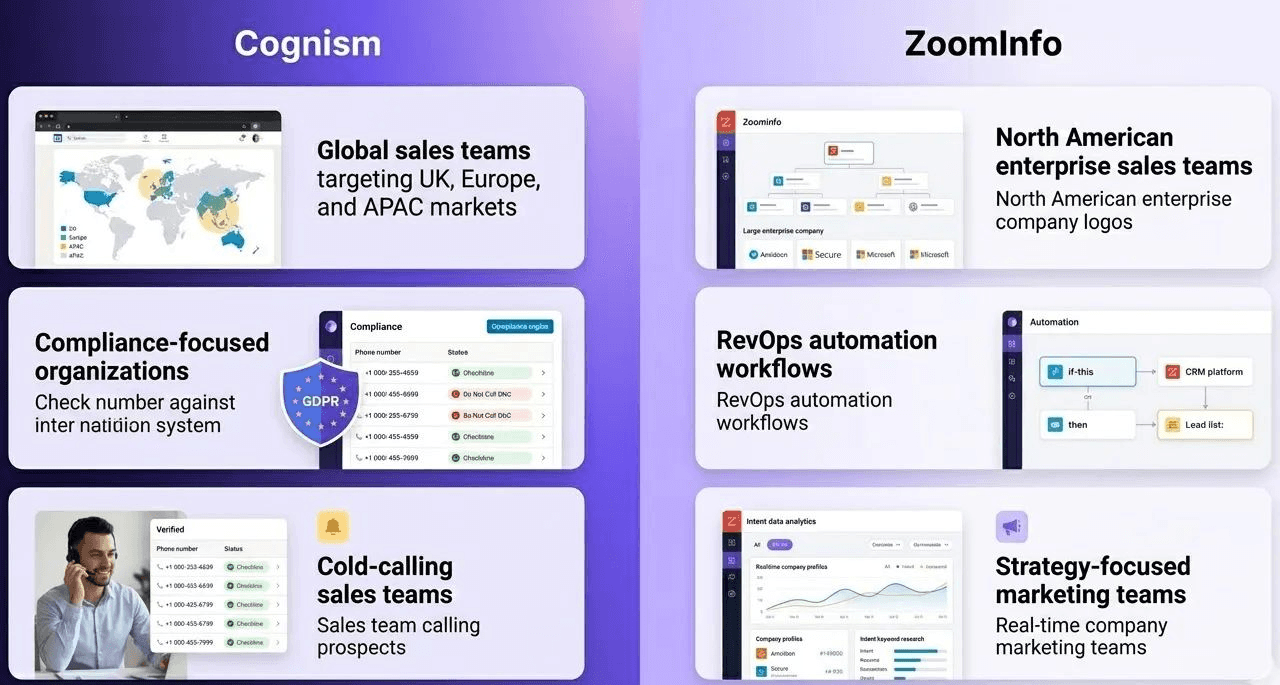
One is built for surgical precision in highly regulated markets, while the other is designed for sheer dominance and market intelligence at enterprise scale.
Who Should Use Cognism?
Cognism is the clear winner for teams that prioritize the "quality over quantity" mindset, especially if your primary target is outside of North America. It’s built for the sales leader who values their reps' time and wants to stay on the right side of international privacy laws.
Teams Targeting the UK, Europe, or APAC: If your territory spans international markets, Cognism is your primary tool. They include global data as standard, saving you from the "data passport" fees other tools charge.
Compliance-Conscious Organizations: If your legal team is strict about GDPR or you are worried about calling people on "Do-Not-Call" (DNC) lists, Cognism’s 15-country scrubbing service acts as your safety net.
Cold Calling Specialists: If your sales strategy relies on calling prospects, you need their Diamond Data. It’s for teams that would rather have 10 verified mobile numbers than 100 unverified office lines.
Who Should Use ZoomInfo?
ZoomInfo is the "gold standard" for massive enterprise teams that need to map out every corner of the North American market. It is for organizations with the budget to invest in a comprehensive "Go-To-Market" operating system rather than just a contact database.
North American Enterprise Sales: If you are selling to the Fortune 500 or large mid-market companies in the US and Canada, ZoomInfo’s depth of data is simply unmatched by anyone else in the industry.
Revenue Operations (RevOps) Leaders: Ideal for those who need to automate complex workflows, like "If a company raises Series C funding and uses AWS, automatically assign it to an account executive."
Strategy-Heavy Marketing Teams: Perfect for marketers who need "Intent Data" to see which companies are currently researching their specific keywords across the web.
Pros and Cons of Cognism vs ZoomInfo
Evaluating pros and cons helps teams align platform capabilities with outreach, enrichment, and budget priorities.
Cognism Pros and Cons
Cognism is widely viewed as the go-to specialist for teams that prioritize verified mobile data and strict international privacy compliance. It’s an investment in surgical precision, offering a "clean" prospecting experience
Cognism Pros
GDPR/CCPA compliant: Ensures safe international outreach.
Global coverage: Access to contacts across multiple regions.
Outbound-ready lists: Pre-validated contacts for email, calls, and LinkedIn campaigns.
Lead enrichment automation: Append firmographic and contact data efficiently.
Cognism Cons
Limited analytics: Less robust reporting compared to enterprise intelligence platforms.
Lower depth in US enterprise data: Some US company profiles may have less granularity.
Subscription cost: A higher starting price may not suit very small teams.
ZoomInfo Pros and Cons
ZoomInfo remains the undisputed heavyweight of market intelligence, providing a depth of company data that no other platform can currently match.
ZoomInfo Pros
Comprehensive company and contact intelligence: Deep firmographics, technographics, and intent data.
CRM and marketing integration: Synchronizes enriched data with internal workflows.
Lead scoring and analytics: Prioritize high-value prospects efficiently.
High-volume reliability: Suitable for large sales and marketing teams.
ZoomInfo Cons
Less focus on global compliance: GDPR features present, but global outreach workflows may require caution.
Learning curve: Advanced features and dashboards require initial setup and training.
Cost scaling: Enterprise plans and multi-seat deployments can become expensive.
Which One Is a Better Option?
Global compliant outreach versus enterprise-grade intelligence and workflow integration. Cognism is ideal for teams that need GDPR-compliant global leads, pre-validated prospect lists, and outbound-ready campaigns. Its strength lies in enabling multi-region outreach while minimizing privacy risk, making it perfect for startups and mid-market companies expanding internationally.
ZoomInfo is better suited for mid-market to enterprise teams that require comprehensive company and contact intelligence, integrated CRM enrichment, intent data, and analytics dashboards. It excels in data depth, workflow integration, and high-volume enterprise usage.
For teams that want verified, multi-source contact and company enrichment without managing complex platforms or campaigns, FullEnrich offers over 20 provider waterfall enrichment through a pay-for-results model with 50 free leads. It provides reliable B2B data without the overhead of technical setup, global compliance management, or enterprise-grade subscription costs.
Also Read: 12 Best Data Enrichment Tools
Frequently Asked Questions (FAQs)
Can I use these platforms for ABM campaigns?
Yes. ZoomInfo offers account-level intent data, firmographics, and technographics ideal for ABM. Cognism provides global prospect lists and segmentation tools, making it suitable for targeting key accounts in multi-region campaigns.
How do the platforms handle GDPR and CCPA compliance?
Cognism is built around compliance-first workflows that automatically filter and validate contacts for legal outreach globally. ZoomInfo provides compliance documentation and GDPR tools, but requires teams to manage compliance in outbound campaigns.
Which platform is better for accelerating the pipeline?
Cognism accelerates the pipeline through pre-validated outbound-ready lists and automated prospect enrichment. ZoomInfo accelerates pipeline by combining enrichment, intent data, and integrated workflows for data-driven targeting.
Do these platforms support segmentation by technographics?
ZoomInfo provides technographic filters and company tech stack insights for targeted campaigns. Cognism focuses on firmographics and role-based targeting but has limited technographic data compared to ZoomInfo.
Can I integrate these platforms with marketing automation tools?
Yes. Cognism integrates with HubSpot, Salesforce, and outreach tools. ZoomInfo integrates with HubSpot, Marketo, Pardot, and other marketing automation platforms to route leads and support ABM campaigns.
Which platform is better for small sales teams?
Cognism is better suited for small teams targeting global markets with ready-to-use prospect lists. ZoomInfo is better for teams that need deeper analytics, intent data, and enterprise-level integrations, even at a smaller scale.
Can these platforms help identify new market opportunities?
Yes. ZoomInfo’s intent data and firmographic filters help discover new verticals and high-interest accounts. Cognism’s global coverage enables teams to identify untapped markets and generate verified leads for outbound campaigns.
Which platform offers better support for international outreach?
Cognism provides dedicated compliance support and international coverage guidance, making it ideal for multi-region campaigns. ZoomInfo offers strong US-based support and enterprise assistance, but may require additional setup for global outreach.



Other Articles
Cost Per Opportunity (CPO): A Comprehensive Guide for Businesses
Discover how Cost Per Opportunity (CPO) acts as a key performance indicator in business strategy, offering insights into marketing and sales effectiveness.
Cost Per Sale Uncovered: Efficiency, Calculation, and Optimization in Digital Advertising
Explore Cost Per Sale (CPS) in digital advertising, its calculation and optimization for efficient ad strategies and increased profitability.
Customer Segmentation: Essential Guide for Effective Business Strategies
Discover how Customer Segmentation can drive your business strategy. Learn key concepts, benefits, and practical application tips.